Biology paper? An Overall Analysis of what I have Learned in Bio. Justin Smith, 3rd period.
First of all I think I will tell you why this is important to me, so while you read this long paper you will have some idea what I thought. I think the most important things that I have learned so far is how the human body works. This is important because I am a human, as I a sure by now you know, and it is nice to know what is going on inside of me. I find it interesting how complicated everything is. I never knew half of this stuff before entering this class. It is amazing to me all of the big things that happen so quickly!
One subject that I found interesting was about lactic acid and how we make energy using it. We make energy with lactic acid in the process of fermentation. I play baseball and I used to play soccer, now I see how when we run out of oxygen how our bodies make energy. I thought that was interesting to know.
CELL RELATED SUBJECTS?
If I remember correct, which I think I do, the first major thing we did we part of the cell. We learned about the mitochondria and how it makes ATP. At this point we were like "alright that makes no sense but you?re the teacher so what ever." At least I was. Of course in the next week or two we started to learn about glucose and other sugars, which then go through the Kreb Cycle and the Calvin Cycle. Their end products are ATP, now everything started to flow a little. (a good thing!)
We stared learning about osmosis and diffusion, just words with no meaning for a few days. I figured out what that was just about the time we moved on to Isotonic, Hypertonic, and Hypotonic solutions. In Hypertonic there is a high concentration of the given molecule outside of the cell. Diffusion is the movement of particles from a higher concentration to a lower concentration. So in a hypertonic solution to make it to a "happy" Isotonic solution you need to use diffusion. Osmosis is where the water will move to the higher concentration of solute.
After this we started talking about Active Transport. The first we talked about was endocytosis- the cell eats or drinks a substance. Second Phagocytosis- "cell eating"
Third Pinocytosis-the cell will bring in fluids by fusion.
We went on to photosynthesis next. (Defiantly one of the most important processes to understand about a cell.) It is the way the plant takes in sunlight through the chlorophyll to make ATP and NADPH energy for the cell. Again going back to when we learned about chlorophyll linking it up to photosynthesis.
DNA, RNA RELATED SUBJECTS?
After the cell subject was over we made kind of a drastic change to DNA. The first subject was memorizing the bases. (Adenine, Guanine, Thymine, and Cytosine.)
(Not the best way to start but you can only look up from there.) We started to learn about the structure of DNA, the double helix and how it has anti-parallel strands. Then the functions of DNA, replication and and to pass genes on your offspring. (I will skip the stuff about codes and codons?easy stuff.)
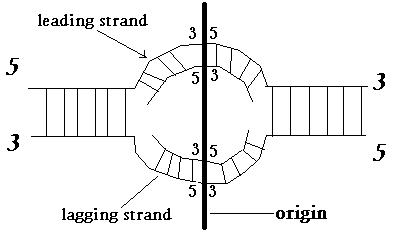
We then stared to learn about how DNA can replicate itself. We learned the parts
There they are?made the picture myself.
We also learned that they were made of a phosphate group, a base, and finally a nucleotide. We did the big long list on the DNA packing:
-starts as chromatin
1st level-"beads on a string" ?you know what I am talking about.
We just started RNA learning how it is single stranded and how it is made from the code of the DNA. The differences in RNA and DNA, RNA is single stranded where DNA is double stranded. Again you were putting everything we learned about DNA together to teach us about RNA. Today, the day I am writing this paper we learned how to read the codes in RNA. Example.
5? ? ACG !AUG! !CUA! !GGG! !UGA! CCU- 3?]
this is where we ended!
I am really enjoying this class. I hope that all of the units for the rest of the year are as fun and exciting as the last were. (and thanks for letting me have Pepsi in class! I love that stuff)
Go back